
Trump evacuation after gunfire exposes security gap at high-profile Washington event
Washington DC, 26 April 2026, (Forelines) — The evacuation of US President Donald Trump from the White House Correspondents’ Dinner after gunfire near a security checkpoint has prompted a federal investigation into how an armed suspect was able to approach a controlled…
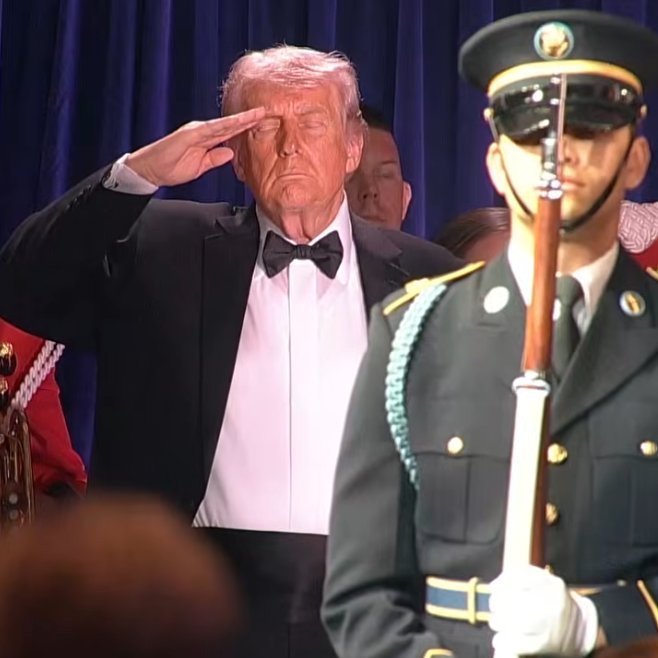
Washington DC, 26 April 2026, (Forelines) — The evacuation of US President Donald Trump from the White House Correspondents’ Dinner after gunfire near a security checkpoint has prompted a federal investigation into how an armed suspect was able to approach a controlled access point at one of the most tightly protected gatherings in the United States.
Officials say the suspect was detained within seconds and that no senior figures were injured. But the location of the incident—at a magnetometer screening zone separating public access from secured space—has focused attention on a longstanding challenge in event security: the vulnerability of outer perimeters.
What is confirmed
According to US authorities, the incident occurred shortly after the event began at the Washington Hilton, where senior political figures, journalists and public officials had gathered.
A suspect approached a security checkpoint and discharged a firearm. Law enforcement officers stationed nearby intervened immediately and took the individual into custody.
Agents from the United States Secret Service escorted President Trump and other protected officials from the venue as a precaution. Authorities later said there was no ongoing threat and no fatalities were reported.
Officials have said the suspect is believed to have acted alone, though details about identity and motive remain limited.
What remains unclear
Despite the rapid containment of the threat, several key questions remain unresolved.
Authorities have not publicly detailed how the suspect reached the checkpoint while armed, nor whether the individual had been identified as a potential risk before the incident.
It is also unclear whether the suspect conducted prior reconnaissance of the venue or exploited a specific gap in perimeter controls.
Investigators from the Federal Bureau of Investigation, working alongside the Department of Homeland Security, are expected to examine these factors as part of an ongoing review.
Reconstructing the incident
Witness accounts indicate that the situation developed rapidly.
Attendees inside the ballroom reported hearing a loud noise before security personnel initiated emergency procedures. Guests were directed to take cover as agents moved to secure the area.
President Trump, seated at a central table, was surrounded by agents and escorted from the room. Other officials were either evacuated or secured in place depending on their location.
At the checkpoint, officers subdued the suspect within seconds of the first shot being fired.
Where the system was tested
Security at events such as the White House Correspondents’ Dinner operates through layered protection, extending from an outer perimeter to a highly controlled inner zone.
The incident appears to have occurred at a transitional layer between these zones—an area where individuals have not yet been fully screened but are approaching controlled access.
Security experts have long identified these areas as among the most difficult to secure.
Paul Rosenzweig, a former senior official at the Department of Homeland Security, has noted in public discussions that outer security layers must balance access with control, making them inherently more complex than inner perimeters.
Structural constraints
The Washington Hilton presents particular challenges for security planning.
Unlike fixed government sites such as the White House, the hotel remains an active, multi-entry venue during the event. Guests, staff and media move through shared spaces, requiring security teams to manage multiple access routes simultaneously.
These conditions create what security planners describe as “soft perimeter” environments—areas that are monitored but not fully restricted.
A broader pattern
Analysts say the incident is consistent with a wider pattern in which attacks or attempted attacks target entry points rather than heavily secured interiors.
Such locations include screening checkpoints, queues and public-facing access corridors—areas where individuals can approach before undergoing full security checks.
This reflects a shift in threat dynamics, where proximity rather than penetration becomes the primary objective.
Official response
Donald Trump later said he had been advised to leave as a precaution and confirmed that attendees were safe, praising the actions of security personnel.
Authorities said there is no indication of a broader or coordinated threat. The suspect remains in custody as investigations continue.
How close was too close?
The incident lasted only seconds, and the immediate threat was contained. But its significance lies not in the speed of the response, but in the proximity of the risk.
An armed individual reached a critical access point at one of the most tightly secured political events in the United States. For investigators, the question is not simply whether the system worked—but whether it worked early enough.
In modern security planning, success is measured not only by outcomes, but by distance. In this case, that margin appears uncomfortably narrow.
Cite this analysis
Disha Mishra, “Trump evacuation after gunfire exposes security gap at high-profile Washington event,” Forelines Analysis, 26 April 2026, https://forelines.com/trump-evacuation-after-gunfire-exposes-security-gap-at-high-profile-washington-event/.

Written by